Frankly, after so many years in this industry, I've seen far too many cases of "collaboration failures."
Clients come to us with a list of requirements, factories confidently declare, "We can do it all!" But when the samples come out, heat dissipation issues remain unresolved, power supply solutions are unstable, and even basic EMC testing fails. In the end, both sides blame each other, the project is delayed, and market opportunities are lost.
Where did the problem lie? In my opinion, the root cause lies in a common misconception: many people simply understand ODM as "I provide the ideas, you provide the labor."
But true ODM, especially for products like PoE switches that have extremely high requirements for stability, compatibility, and security, is never a mechanical conversion process from "blueprints to finished product." It's a joint design process that requires deep collaboration between both parties during the R&D phase.
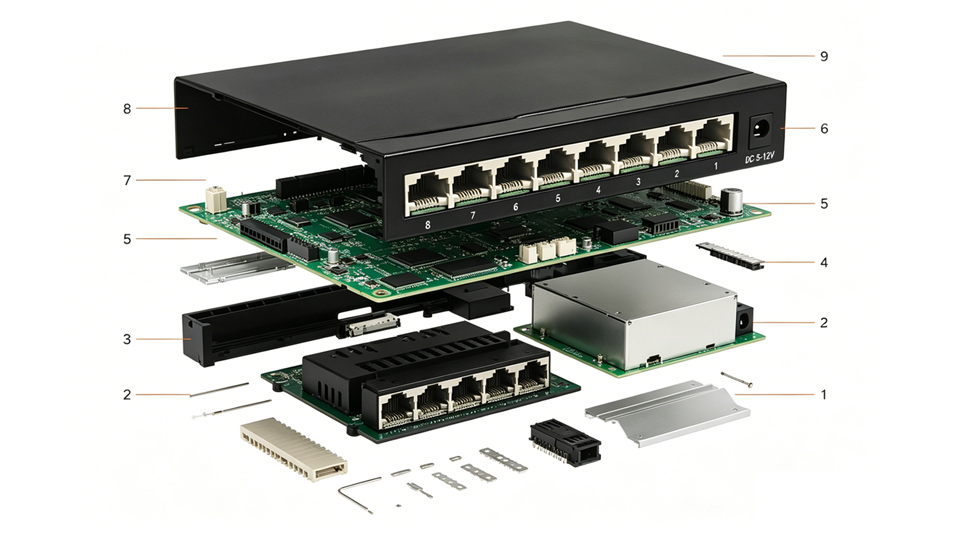
A Lesson That Left a Deep Impression
Several years ago, I assisted a team developing smart security solutions with the selection of PoE switches. Their needs were clear: they needed an 8-port gigabit PoE switch with a total power of 120W, capable of simultaneously powering 6 cameras and 2 wireless access points, and operating within a temperature range of -20°C to 60°C.
Frankly, this requirement wasn't particularly complex. The problem lay in the details.
The first supplier they found produced a sample according to a standard solution. Everything worked perfectly in the lab tests, but it all fell apart on-site. Why? Because the on-site installation environment was in an outdoor waterproof enclosure, where the internal temperature could soar above 70°C at midday in summer. The electrolytic capacitors used in the standard solution simply couldn't withstand such prolonged high temperatures; they started bulging after three months, causing the switch to frequently restart.
This wasn't a production problem; it was a problem of not fully understanding the actual application scenario during the R&D phase.
Later, we changed our cooperation model. With the involvement of the engineering team at Newbridge Communication Equipment CO.,LTD., both parties sat down and spent two weeks conducting a comprehensive joint design review. From component selection (replacing all capacitors with solid-state capacitors) to PCB layout (optimizing heat dissipation channels) and power management strategies (adding temperature control derating mechanisms), every step was re-tested under the "worst-case scenario."
The result? Over the next three years, this product shipped over 50,000 units, with a failure rate kept below 0.3%.
This experience made me realize that the value of ODM for PoE switches goes far beyond simply "producing according to drawings."
Three Core Value Points of Co-design
Based on years of experience, I have summarized three key dimensions where R&D support truly creates value under the co-design model:
1. Deep Customization of Power Supply Architecture
The core of a PoE switch is power supply. However, many customers easily overlook the fact that the IEEE 802.3af/at/bt standards are only the foundation; the real challenge lies in adapting the power supply solution to specific terminal devices.
For example, the startup current of some infrared PTZ cameras is three times that of normal operation. If designed according to the standard, problems such as "overload protection upon power-on, resulting in repeated device restarts" may occur. Experienced ODM R&D teams will perform targeted optimizations in PSE chip selection, MOSFET driver circuit design, and even firmware-level power management algorithms.
I usually advise clients to provide the ODM R&D team with a "list of end devices" at the project initiation stage. The more detailed the better—brand, model, actual power consumption curve, startup characteristics. This information determines the redundancy design and protection strategy of the entire power supply architecture.
2. Engineering Balance Between Heat Dissipation and Reliability
This is the most problematic area, and also where R&D prowess is most evident.
The heat generated by PoE switches under full load is not to be underestimated. For example, a 24-port gigabit PoE switch, if each port outputs 30W, easily exceeds 750W in total power consumption. This is not a problem that can be solved simply by "adding a fan."
Excellent collaborative R&D approaches the issue from three levels:
Component Level: Selecting MOSFETs with lower on-resistance and higher-efficiency DC-DC converters.
PCB Level: Optimizing the separation of power and signal layers, and the thickness and area of copper foil.
Structural Level: Airflow design, heatsink shape, and selection of thermal pads.
I remember a customer working on Industrial IoT who had strict noise requirements and couldn't use fans. We ultimately controlled the overall temperature rise below 45℃ using a solution of "integrated heatsink fins + thermally conductive potting compound." This solution wasn't readily available; it was developed through repeated testing and iterations by engineers from both sides in the lab.
3. Software Protocol Compatibility Verification
This is the most easily underestimated aspect.
PoE switches are more than just "power supply + data forwarding." The compatibility of protocols like LLDP, SNMP, RSTP, and VLAN in a real-world network environment directly determines whether the device can operate stably.
I once encountered a case where a customer's NVR needed to read the switch's port power status in real time via SNMP for fault warning purposes. The results showed that many switches on the market use "crippled" SNMP MIB libraries, completely lacking support for PoE-related OID nodes.
This isn't a hardware issue, but in real-world projects, it can render the entire system unusable.
Therefore, I now emphasize that during the joint design phase, the "software feature list" and "network management requirements" must be clearly defined. Which protocols need to be supported? Which network management platform will be used? Are there any special proprietary MIB requirements? The earlier these questions are addressed, the lower the probability of encountering problems later.
A Practical Collaboration Framework
Based on this experience, I have summarized a three-stage collaboration framework for your reference:
Stage 1: In-depth Requirements Analysis (1-2 weeks)
This involves more than just looking at the parameter table. I would advise clients to clearly describe the "physical environment" and "network environment" in which the switch will operate. Temperature range? Installation method? Management platform? Types of terminal devices? Are there any special industry certification requirements (e.g., EN50155 for rail transportation, IEC60601 for medical equipment)?
Phase Two: Joint Review (1 week) Engineers from both sides sit down together to review the schematics and PCB layout item by item.
Key areas of focus include: power architecture margins, the calculation basis for the heat dissipation solution, the lifespan estimation of key components, and the coverage of software functions.
Phase Three: Prototype Verification (2-4 weeks) Rapid prototyping is conducted, but not just in the lab.
I would advise the customer to run several prototypes in real-world scenarios, especially under "edge conditions"—high temperature, low temperature, full load, plug-in surges, and even grounding conditions during thunderstorms. These issues cannot be simulated by standard lab tests.
Some Reminders That Might Be Helpful
At this point, I'd like to offer some practical advice to those choosing a PoE switch ODM partner:
First, don't prioritize price.
A stable and reliable power supply solution can vary by more than 30% in component costs alone. The money saved will ultimately become after-sales costs and customer complaints.
Second, value the R&D team's experience.
Ask the engineers: What similar projects have you done before? What typical failures have you encountered? How did you resolve them? A team that has experienced the pitfalls of problem-solving is far more valuable than those that simply copy reference designs.
Third, establish an effective communication mechanism.
The biggest fear in collaborative design is information asymmetry. The best practice I've seen is: establish a shared project dashboard, with all technical documents, test reports, and issue lists updated in real time. A weekly online alignment meeting, without fail.
Fourth, allow sufficient verification time.
There are no shortcuts to verifying the reliability of PoE switches, especially high and low temperature cycling tests and long-term aging tests. Products rushed out will ultimately be returned in a more devastating way.
In conclusion, to be honest, while writing this article, I kept recalling the pitfalls, lessons learned, and joys I've experienced in the PoE switch field over the years.
This industry has a unique characteristic: truly good products go unnoticed by users. Cameras function normally, wireless APs maintain stable connections, and access control systems respond instantly—when everything is going smoothly, no one thinks about "the switch behind the scenes."
But once a problem arises, it becomes the first suspect. Therefore, I've always believed that being an ODM for PoE switches is essentially doing "invisible work." All your efforts—precise power supply design, stringent heat dissipation solutions, and repeated protocol verification—ultimately aim to make users forget your existence.
This is why I increasingly value joint design and R&D support. Only when both parties truly collaborate and perfect every detail can you produce a product that you "won't feel the difference even after three years of use."
As someone who has been deeply involved in this industry, I'm willing to share what I've seen, learned, and encountered without reservation. Because I believe that only when the overall product quality of the industry improves will each of our efforts have true value.