With over a decade of experience in the network communication equipment field, I've handled countless PoE switch testing projects, from the simplest 100Mbps port devices to today's complex models integrating AI management, long-distance transmission, and industrial-grade protection. I've come to realize that standardized testing is no longer sufficient to meet the quality assurance requirements of today's high-end PoE products. Only tailor-made, customized testing solutions can truly safeguard the delivery quality of complex devices.
My company, Newbridge Communication Equipment CO.,LTD., focuses on the R&D and production of PoE switches, often dealing with scenarios such as smart security, industrial automation, and smart cities, where network stability and power supply reliability requirements are extremely demanding. Three years ago, we received an order for a rail transit project. The client needed a 24-port gigabit PoE switch that not only supported IEEE 802.3bt 90W high-power supply but also required wide-temperature operation from -40℃ to 85℃, 6KV surge protection, strong electromagnetic interference immunity, and over ten complex functions including VLAN isolation, port mirroring, and link redundancy.
Initially, we used traditional factory testing procedures, performing only basic power supply testing, data transmission testing, and 48-hour ambient temperature aging. As a result, the first batch of prototypes delivered to the client's site experienced three consecutive power outages and partial data packet loss under low-temperature startup and full-load power supply combined with data transmission. The on-site engineers worked through the night to investigate and discovered that the collaborative stability between the power supply module and the data switching chip under extreme conditions had not been fully verified, and conventional testing did not cover such complex scenarios.
That lesson taught me a profound lesson: the quality of a complex PoE switch is never the sum of a single performance indicator, but rather the stability of all functions operating collaboratively in real-world application scenarios. Since then, we have completely restructured our testing system, creating customized testing solutions for each complex feature model, nipping any potential impact on delivery quality in the bud before it leaves the factory.
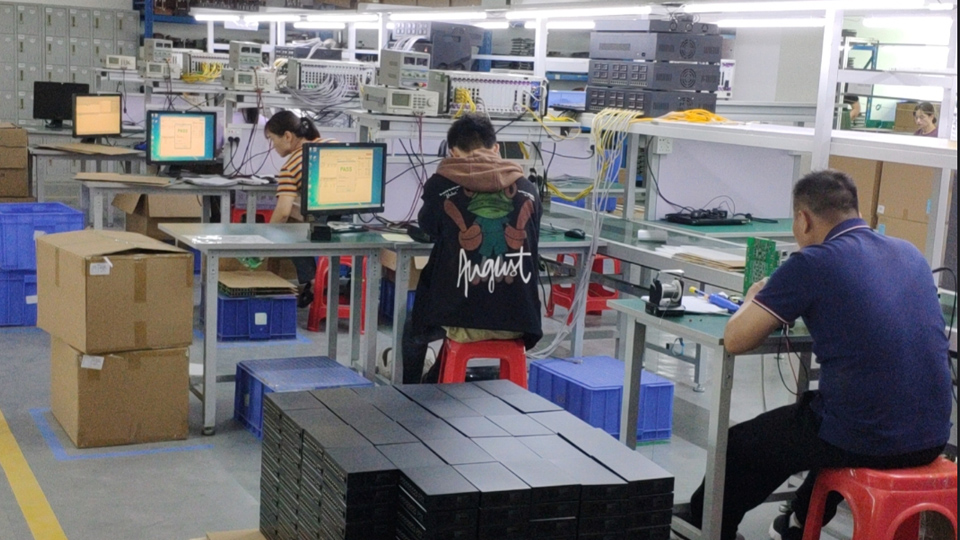
The Core of Customized Testing: Understand the Product First, Then Design a Solution
The first step in customized testing is not blindly piling up test items, but rather deeply analyzing the product's functional characteristics, application scenarios, and risk points—three core elements—ensuring that every test precisely targets the product's "Achilles' heel."
1. Functional Breakdown: Leaving No Complex Feature Unexamined
For PoE switches integrating multiple complex functions, we meticulously analyze each function, clarifying its technical standards, performance thresholds, and interaction logic:
Power Supply Capability: Differentiating between IEEE 802.3af/at/bt standards, confirming maximum power per port (15.4W/30W/90W), total power consumption, power allocation strategy, and compatibility with non-standard equipment;
Data Performance: Port speed (100Mbps/1Gbps/2.5Gbps), backplane bandwidth, packet forwarding rate, latency and jitter metrics, packet loss rate standards;
Special Functions: AI intelligent management, long-distance transmission (150m/250m), port mirroring, loop detection, QoS priority, DHCP Snooping, industrial-grade redundancy protocols;
Environmental Adaptability: Temperature and humidity range, protection level, surge protection metrics, electromagnetic compatibility, vibration and shock tolerance.
2. Scenario Recreation: From Laboratory to Real-World Conditions
Testing divorced from application scenarios is merely "theoretical." We will deeply integrate with our customers' usage environments, replicating the complex variables of real-world operating conditions on a 1:1 scale:
Industrial Scenarios: Overlaying high temperature and humidity, dust, strong electromagnetic interference, and frequent voltage fluctuations to test the continuous operational stability of the equipment;
Security Scenarios: Simulating the instantaneous power surge from simultaneous activation of multiple high-definition cameras, sudden load changes when infrared cameras are activated at night, and power loss over long-distance network cables;
Outdoor Scenarios: Introducing high and low temperature cycles, rain erosion, and lightning surges to verify the equipment's uninterrupted operation capability under extreme weather conditions.
3. Risk Prediction: Focusing on the Most Vulnerable Links
Based on years of testing experience, we will proactively identify high-risk points in complex PoE switches and design targeted reinforcement tests:
Power overload and temperature spike risks under multi-port full-load power supply + data concurrency;
Protocol negotiation failure risks when high-power PD devices (such as PTZ cameras, WiFi 6 APs) are connected;
Performance degradation and failure risks of hardware components (capacitors, chips, interfaces) under extreme environments;
System conflicts and crashes risks when complex functions are implemented in parallel (such as power supply + QoS + loop detection).
In-depth Analysis: Five Core Modules of a Customized Testing Solution
Through countless iterations and optimizations, we have developed five core testing modules covering basic performance, power supply, data transmission, environmental adaptation, and system stability. These modules can be flexibly combined and precisely adjusted for different products to ensure comprehensive coverage of all quality dimensions of complex PoE switches.
Module 1: Basic Hardware and Compatibility Testing – Building a Solid Product Foundation
This is the foundation of all testing, focusing on verifying the integrity and basic compatibility of the device hardware to prevent basic defects from flowing into subsequent stages:
Hardware Testing: Check the physical integrity of interfaces, indicator lights, heat dissipation structures, and casing protection; verify that component models, specifications, and design schemes are consistent.
Protocol Compatibility: Interact with PD devices (IP cameras, wireless APs, IP phones) of different brands and standards; verify the success rate of IEEE 802.3af/at/bt protocol negotiation; ensure that non-standard devices can be correctly identified and powered.
Port Adaptability: Test 10/100/1000Mbps auto-sensing and MDI/MDI-X auto-sensing; confirm the compatibility with different types of network cables (Cat5e/Cat6/Cat6a).
Module 2: PoE Power Supply Testing – Safeguarding the Lifeline of Core Functions
Power supply is the core value of a PoE switch and also the most prone to problems in complex models. We have designed a series of sophisticated tests that far exceed industry standards:
Graded Power Testing: Testing the power output of Class 0-Class 8 ports one by one to verify whether the actual power, voltage, and current of a single port meet the standards (44-57V DC), ensuring stable output from 90W high-power ports;
Full Load and Overload Testing: Connecting all ports to a fully loaded PD device simultaneously and running continuously for 72 hours, monitoring overall power consumption and temperature changes to verify the accurate triggering of the overload protection mechanism;
Dynamic Load Testing: Simulating frequent device start-stop and power surge scenarios (such as camera infrared switching), testing voltage fluctuations ≤±5% and recovery time ≤100μs to prevent power interruptions;
Abnormal Protection Testing: Artificially creating scenarios such as network cable short circuits, reverse connections, and undervoltage/overvoltage to verify whether the device automatically cuts off power to the faulty port, issues alarms, and does not affect the normal operation of other ports.
Module 3: Data Transmission Performance Testing – Ensuring Smooth and Stable Network Performance
PoE switches must not only provide power but also transmit data efficiently. Complex models, in particular, require a balance between power supply and data transmission performance:
Throughput Testing: Using a professional network tester, data throughput is tested at different frame lengths (64-1518 bytes) under no-load, half-load, and full-load power conditions to ensure no attenuation of gigabit port speeds.
Latency and Jitter Testing: Data transmission latency and jitter values are measured. Industrial-grade models are required to have latency ≤50μs and jitter ≤10μs to meet the needs of real-time control scenarios.
Concurrency and Stress Testing: Multiple ports simultaneously transmit high-definition video and large files, simulating 70%-100% bandwidth utilization, verifying a packet loss rate ≤0.1% without stuttering or interruptions.
Complex Function Collaboration Testing: While enabling VLAN, QoS, port mirroring, and other functions, power supply and data transmission tests are performed to ensure parallel functionality without conflict or performance degradation.
Module 4: Industrial-Grade Environmental Adaptability Testing – Meeting Extreme Operating Conditions
For PoE models designed for complex industrial and outdoor scenarios, we have developed rigorous environmental tests that far exceed the standards of ordinary commercial equipment:
High and Low Temperature Cycling Test: 10 cycles (8 hours each) within a -40℃ to 85℃ chamber to test the equipment's startup, operation, and functional stability;
Damp Heat and Salt Spray Test: 72 hours of continuous damp heat testing at 40℃ and 95% RH, followed by 48 hours of neutral salt spray testing to verify no corrosion or performance degradation of the casing and components;
Lightning Protection and Surge Test: 6KV lightning protection testing for network ports and 4KV for power ports, plus ±4KV surge impact testing to ensure uninterrupted operation and no damage to the equipment under strong lightning strikes and voltage fluctuations;
Vibration and Shock Test: Simulating industrial and automotive vibration scenarios (10-500Hz, 15g acceleration) and a 30g shock test to verify structural robustness and reliable port connections.
Module 5: Long-Term Stability and Aging Testing – Verifying Durable Reliability
Complex function PoE switches are often used in critical projects, requiring long-term trouble-free operation. Our aging tests are far from superficial:
Full-load Aging Test: All ports are fully powered and data is processed concurrently, running continuously for 168 hours (7 days) in a 40°C environment, with continuous monitoring of performance parameters, temperature, and fault points;
MTBF Reliability Verification: Through accelerated aging testing and data analysis, the mean time between failures (MTBF) of the equipment is derived, ensuring that industrial-grade models have an MTBF > 100,000 hours;
Abnormal Restart Test: Simulating sudden power outages, voltage drops, and system restarts, the test equipment ensures that configuration is not lost and functions quickly return to normal after restarting.
From Solution to Implementation: Customized Testing Execution and Management
A comprehensive testing solution relies on rigorous execution processes and meticulous management. We have established a closed-loop system encompassing "Solution Formulation — Test Execution — Data Recording — Problem Rectification — Retesting and Verification":
Dedicated Testing Team: A dedicated team of 3-5 engineers with over 5 years of PoE testing experience is responsible for the entire implementation process, ensuring standardized operation and accurate data for every test.
Professional Testing Equipment: Equipped with high-end equipment such as PoE-specific testers, network performance analyzers, high and low temperature chambers, surge generators, and electronic loads, guaranteeing testing accuracy at the microsecond and milliwatt levels.
Full-Process Data Recording: Parameters, results, equipment status, and anomalies for every test are recorded in real-time and generate customized test reports, ensuring "traceability for every device and verifiability for every performance metric."
Closed-Loop Problem Rectification: Any defects discovered during testing are immediately reported to R&D and production teams for root cause analysis and solution optimization. Only after 100% successful retesting following rectification can the next stage be initiated.
Returning to the aforementioned rail transit project, after reconstructing the customized testing solution, we applied over 20 specialized tests to this 24-port industrial-grade PoE switch, including wide-temperature cycling, full-load power supply + data concurrency, strong electromagnetic interference, and surge impact, accumulating over 200 hours of testing time. The 300 devices ultimately delivered have been running continuously at the customer's site for two years with zero failures and zero complaints, perfectly adapting to the demanding operating conditions of rail transit.
In Conclusion: The Essence of Testing is the Upholding of Quality and Trust
I am often asked, "Is it really necessary to do so much customized testing, which is costly and time-consuming?"
My answer has always been: For complex PoE switches, customized testing is not a cost, but a bottom line for ensuring delivery quality; it is not an extra step, but the most basic responsibility to the customer and the product. A single PoE switch might connect dozens of security cameras, safeguarding city security; it might support the control network of an industrial production line, impacting enterprise production efficiency; it might cover the wireless signal in outdoor scenic areas, carrying the user's network experience—any minor fault could trigger a chain reaction, causing incalculable losses.
We never treat testing as a "pre-shipment process," but rather as a "bridge connecting products and trust." Every customized test design, every data record, and every problem rectification is aimed at ensuring that every complex-function PoE switch leaving Newbridge can operate stably and reliably in its respective scenario.
If you are currently using or about to purchase a complex-function PoE switch, pay close attention to its testing details—truly high-quality products are not built by piling up parameters, but by refining them through precise, rigorous, and customized testing.