Having worked in the PoE switch OEM manufacturing industry for 12 years, from initially learning incoming material inspection from my mentor to now leading the quality control of the entire manufacturing process, I've witnessed too many cases of companies stumbling due to neglecting quality control. Some manufacturers, in an effort to cut costs, skipped key testing steps, leading to unstable power supply issues in batches, causing losses for customers and costing them long-term partnerships. Others, seemingly having established comprehensive quality control systems, merely went through the motions, ultimately letting a tiny process error affect the stability of the entire batch. Today, I don't want to talk about theory; I simply want to share my years of practical experience in PoE switch OEM manufacturing to discuss how a quality control system should be implemented effectively, and which aspects absolutely cannot be overlooked. I hope this will provide some practical guidance for those currently selecting OEM manufacturers or those just entering this field.
In my view, quality control in PoE switch OEM manufacturing is never a matter of a single step, but rather a closed-loop management of the entire process from source to end, from raw materials to finished products. Many people mistakenly believe that quality control is simply the inspection of finished products before they leave the factory. This is far from the truth—true high quality is achieved by meticulously scrutinizing every single component and every step of the process. I've felt this particularly acutely during my years at Newbridge Communication Equipment CO.,LTD. As a manufacturer deeply involved in the R&D, production, and OEM manufacturing of PoE switches, there was no "good enough" attitude here. Quality control standards at every stage were refined to the extreme, and this became the core reference for my later development of the quality control system. Today, I'll share these practical tips with you without reservation.
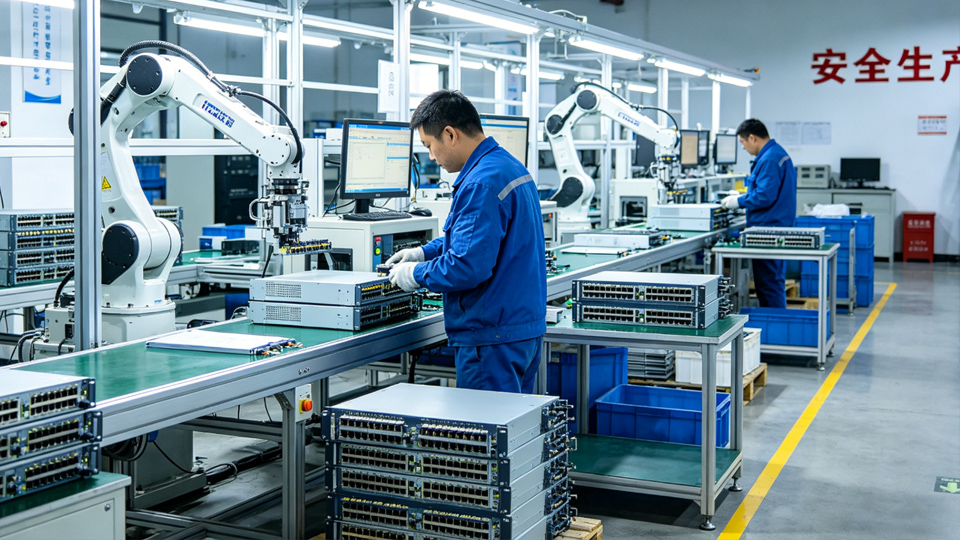
Source control is fundamental—Incoming Quality Control (IQC) must be flawlessly executed.
The core performance of a PoE switch largely depends on the quality of its core components, such as chips, power modules, and PCB boards. Even a small defective capacitor can lead to overheating, power outages, or even equipment burnout during long-term use. I remember when I first started in this industry, I was in charge of incoming material inspection with my mentor. A batch of PCBs appeared to be in good condition, but after testing with professional equipment, it was found that the copper foil thickness did not meet the standard. If they were used directly in production, there would be a risk of unstable signal transmission later on. We decisively rejected this batch of goods. Although it affected the production schedule in the short term, it prevented greater losses later on.
Over the years, I've developed a practical incoming material inspection process that you can refer to: First, establish a strict supplier screening mechanism, prioritizing qualified suppliers with industry reputations. Suppliers are audited every six months, with on-site inspections of their production processes and quality control standards. Unqualified suppliers are resolutely blacklisted. Second, define clear inspection standards. Detailed inspection parameters are developed for different components, such as chip operating voltage, power module output stability, and PCB temperature resistance. Each component must be tested individually. Core components must undergo full inspection, while ordinary components are sampled, with a sampling rate of no less than 30%. Third, establish an incoming material traceability system. Each batch of components is numbered and recorded, clearly indicating the supplier, production batch, and inspection results. This allows for rapid identification of the source and timely rectification should quality issues arise. I'd also like to mention that Newbridge Communication Equipment CO.,LTD. equips its incoming material inspection process with professional testing equipment such as the Agilent 37718A and Tektronix 400MHz digital oscilloscopes to prevent unqualified components from entering the production line. This is a practice worth emulating by all OEM manufacturers.
Process quality control (IPQC) is the core link in quality control.
The production process of PoE switch OEM manufacturing is complex, from SMT surface mount technology (SMT), component insertion, soldering, to assembly and debugging. Each step can potentially lead to quality issues. Process quality control aims to identify and rectify problems as soon as they arise, preventing the production of batches of defective products. I have seen many OEM factories skip process inspections in pursuit of production efficiency, only to discover problems during finished product testing. By then, this has resulted in significant material waste and time losses, ultimately outweighing the benefits.
Based on practical experience, the key to process quality control is to "closely monitor critical processes and ensure comprehensive monitoring throughout the entire process." For example, in the SMT (Surface Mount Technology) assembly process, a core step in PoE switch production, the precision of the assembly directly impacts the product's signal transmission performance. We assign dedicated personnel to monitor the entire process, utilizing machine vision systems to replace manual visual inspection, quickly identifying issues such as assembly deviations and cold solder joints. We also conduct hourly sampling inspections to ensure assembly precision meets standards. In the soldering process, we strictly control soldering temperature and time to avoid issues like cold solder joints and bridging. After soldering, we use optical inspection equipment for comprehensive checks. In the assembly process, we clearly define the installation specifications for each component to prevent poor contact and heat dissipation problems caused by improper installation. Furthermore, we have established a process quality traceability system, using barcodes to record information such as production batch, operator, and testing data for each product. Even a minor issue can be quickly traced back to the specific process and responsible person. This is one of the core secrets behind Newbridge Communication Equipment CO.,LTD.'s long-standing low product failure rate.
Final quality control (OQC) is the last line of defense before the product leaves the factory, and it must be absolutely flawless.
Many customers, when choosing OEM manufacturing, are most concerned about the quality and stability of the finished product. Final inspection is crucial to ensuring the product meets customer needs and operates stably. It's important to note that final inspection is not simply a power-on test; it involves simulating real-world usage scenarios and conducting comprehensive testing to ensure stable operation under various environments.
Our routine final inspection includes three core components:
1. Functional testing: checking the port power supply stability, data transmission rate, VLAN functionality, QoS functionality, etc., of the PoE switch to ensure each function meets the customer's technical requirements.
2. Environmental adaptability testing: simulating industrial scenarios such as high temperature, low temperature, humidity, and electromagnetic interference to test the product's operational stability. For example, placing the product in an environment ranging from -40℃ to 75℃ and running it continuously for 72 hours to observe its operating status ensures the product can adapt to different usage environments.
3. Reliability testing: Conducting long-term full-load operation tests to check the product's heat dissipation performance and lifespan, preventing malfunctions during long-term use. It's worth mentioning that Newbridge Communication Equipment CO.,LTD. also introduces third-party testing agencies to conduct dual verification of finished products, ensuring that they meet ISO9001 quality management system standards, as well as EMC, explosion-proof, and other relevant certification requirements, giving customers greater peace of mind.
Besides these three core aspects, I believe that quality control in PoE switch OEM manufacturing requires attention to two key points: First, personnel training. Even the most comprehensive system ultimately relies on people to implement it. We will establish a tiered training system. New employees must receive basic operation and quality control standard training and pass an assessment before starting work. Senior technicians and quality control personnel regularly participate in industry training to learn new technologies and testing methods. Simultaneously, through case sharing and defect demonstrations, we strengthen the quality awareness of all employees, ensuring that every employee understands that "quality is not inspected, but produced." Second, continuous improvement. Quality control is not static but a dynamic optimization process. We regularly collect customer feedback, analyze quality issues that arise during production, summarize lessons learned, and optimize quality control processes and inspection standards. Simultaneously, we pay close attention to industry technological developments and international quality standards, adjusting production processes and quality control systems in a timely manner to ensure our product quality remains at the forefront of the industry.
Over the years, I have firmly believed that in the PoE switch OEM manufacturing industry, the ultimate competition is not about price, but about quality. Many customers choose us for OEM manufacturing not because of our lowest prices, but because of our comprehensive quality control system and stable product quality. This allows them to avoid after-sales hassles and confidently launch their products to the market. I have also seen some OEM manufacturers lose customer trust and be gradually eliminated from the market by solely pursuing low prices and cutting quality control costs. This has further strengthened my belief: quality is the lifeline of a company. For PoE switch OEM manufacturing, only by ensuring excellent quality control can we win customer trust and gain a foothold in the fierce market competition.